


Early voting kicked off October 19 in Texas, with record turnout throughout 2026’s premier battleground, where the high-stakes US Senate and gubernatorial races are neck and neck, along with six statewide executive offices and four top-targeted US House seats.
Democrats’ dream of taking back the Lone Star State, which hasn’t elected a statewide Democrat in 32 years, is inching closer to reality, with significant national implications for the outcome in the country’s largest Republican state, second only to California in presidential electoral votes.
While Republican Secretary of State Robert Howden is under fire for slow and, in some counties, inaccurate reporting, the Associated Press reported Wednesday that initial early voting was up 74% from the same point in the 2022 midterms.
Based on numbers compiled by Lone Star Left, that number is 43.27% after day four of early voting.
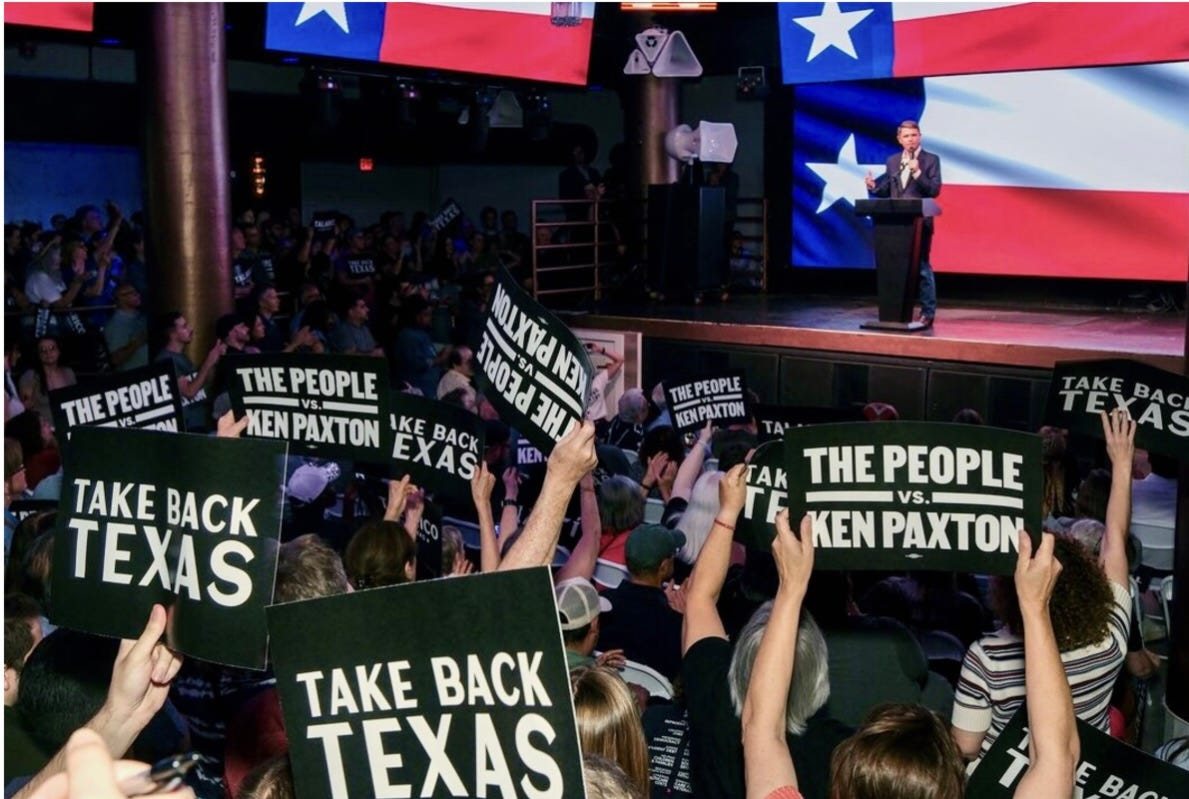
The Lone Star State: Democrats controlled Texas politics for over 100 years, until the 1960s saw small Republican gains, and eventually the defection of conservative Democrats to the GOP in the 1980s. The Bush Family Dynasty solidified the growing dominance of the Republican Party in state politics, which became complete in the national “Republican Revolution” of the mid-1990s.
The GOP controls the Governor's mansion, all statewide offices, and both chambers of the legislature -- which draws the electoral map, subject to veto by the Governor. The last Democratic presidential candidate to win the state was Jimmy Carter in 1976, and Texans have since voted Republican in every presidential election, delivering Trump a near 14-point victory over Kamala Harris in 2024.
Despite the Republican stronghold, rapid population growth and shifting demographics over the last decade have put Texas in play, with a steady increase in Democratic performance on the local and statewide level.
In 2018, Congressman Beto O’Rourke (D) came within 215,000 votes of ousting GOP Senator Ted Cruz. Governor Greg Abbott (R) first won office in 2014 by 20 points, a margin that shrank to 13 points in 2018 and 11 in 2022.
The GOP enjoyed a brief resurgence in 2024, largely due to Lone Star Latino voters, who gave Trump an unprecedented 55% share of their vote. They also helped deliver an 8.5-point victory for Cruz over Congressman Colin Allred (D) -- with a 17-point bump compared to the Senator’s 2018 race.
The landscape for 2026, however, has changed significantly. With Trump’s approval rating at a historically low 33%, and voter rebellion against both the federal and state governments’ handling of the economy, Democrats are poised to reclaim both chambers of Congress.
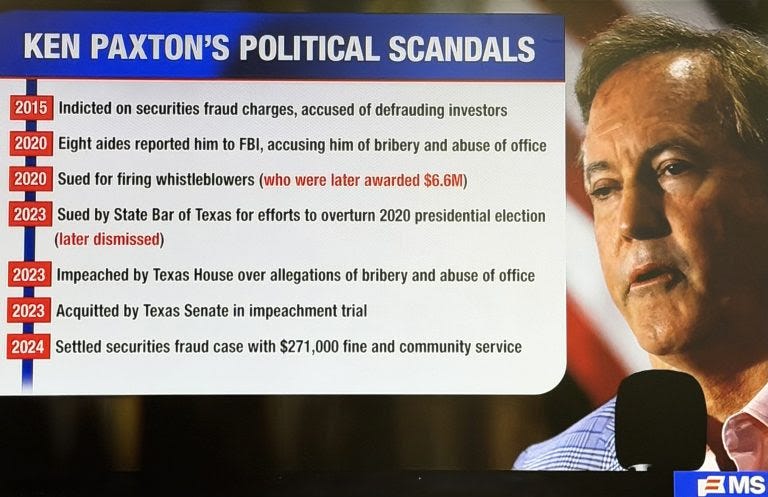
US Senate: The showdown between controversial, alt-right state Attorney General Ken Paxton and Democratic State Representative and Presbyterian seminarian James Talarico has come to symbolize the worst of the Republican Party under Donald Trump versus the hope of a new generation of Democratic leaders answering the call for change.
A longtime Trump ally, the embattled and abrasive Paxton was elected state Attorney General in 2014 and was reelected twice, despite significant legal and ethical controversies throughout his tenure. In 2023, the Texas House impeached him on 20 articles of bribery and abuse of public trust, but the State Senate acquitted him.
Paxton, 63, defeated four-term conservative Senator John Cornyn by 27 points in a May 26 primary runoff after a late Trump endorsement.
Talarico, 37, who defeated Dallas Congresswoman Jasmine Crockett by 6 points in the March Democratic primary, is an eighth-generation Texan, former middle school teacher, and public-education champion from Austin. He flipped a Republican district in a 2018 special election, becoming the youngest member of the Texas House, and three years later was named one of the Top 10 Best Legislators.
A faith-driven populist, Talarico drew early attention as a soft-spoken seminarian with “a choirboy’s face” who articulately blends scripture with avowed progressivism. His compelling floor speeches opposing Christian nationalism and legislation mandating the posting of the Ten Commandments in Texas public schools helped fuel a large national social media following.
Talarico was one of the most visible faces of Texas' highly publicized 2025 mid-decade redistricting battle, and in February 2026, Stephen Colbert made him a household name after CBS pulled his Late Show interview with the Senate candidate, sparking a public censorship dispute. In September, Jimmy Kimmel was forced to do the same under pressure from the FCC via the Trump administration, opting to show it on YouTube instead -- drawing over eight million viewers. Talarico currently boasts over 5.1 million social media followers.

Talarico has raised $134 million with $14.6 million cash on hand as of September 30. AdImpact reports $3.7 million in outside ad spending on his behalf.
Comparatively, Paxton raised just $19.4 million through Q3 and had $4.9 million on hand. He is largely dependent on outside support, including $100 million from the GOP’s Senate Leadership Fund, $33.7 million in ad spending from MAGA Inc., and more than $19 million from Lone Star Liberty PAC, which includes Elon Musk among its top donors.
In total, ad spending has reached $442 million, the second-most expensive non-presidential race on record. Republicans account for about $326 million and Democrats $116 million.
An October 17-19 poll of likely voters by Emerson College/Nexstar showed Talarico and Paxton in a statistical dead heat at 48%-46%, respectively, with 1% supporting Libertarian Ted Brown and 5% undecided (MOE: ±3.1%). Among Hispanic voters, Talarico leads Paxton 57.7%-32.7%, an increase of 10 points since September.
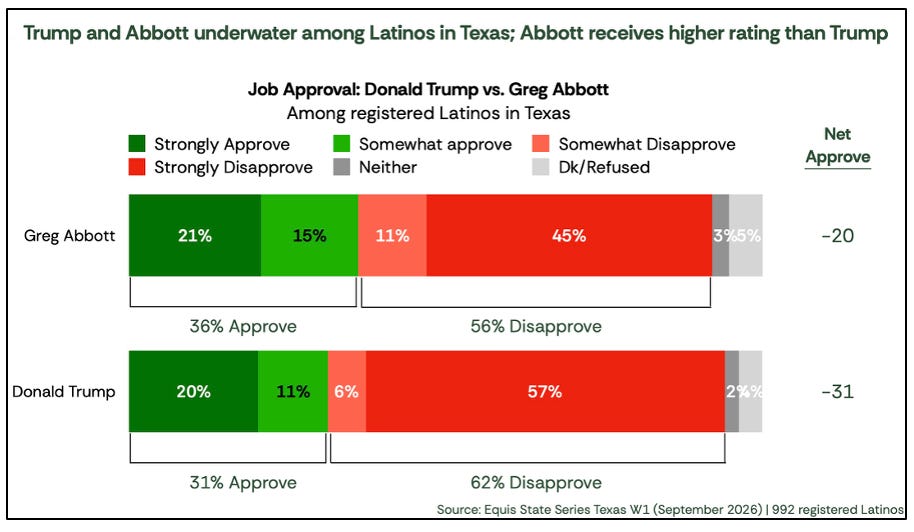
Texas’ Hispanic population, now 40% of the state and 32% of eligible voters (which has more than doubled since 2000), has swung sharply away from the GOP amid discontent over the economy and the administration’s mass deportation policies. Trump’s approval rating among Lone Star Latinos stands at just 31%.
Governor: Incumbent Greg Abbott (R), seeking a fourth term, narrowly leads five-term Austin State Representative Gina Hinojosa, a former civil rights and labor lawyer.
In the Emerson College poll, Abbott led Hinojosa 49%-45%, with Libertarian Pat Dixon securing 1% and 4% undecided. Among Hispanic voters, Hinojosa leads Abbott 57.5%-35.6%, a 22-point margin.
Hinojosa has raised more than $20 million since January, while Abbott, who entered the year with $106 million, has burned through most of it, spending $74 million from July through September alone. As of September 24, Abbott reported $18.2 million in cash on hand, compared with Hinojosa’s $4 million.
Lieutenant Governor: Incumbent Republican Dan Patrick, seeking a fourth term, faces four-term Austin State representative Vikki Goodwin (D). An October 10–14 University of Houston poll showed Patrick leading Goodwin 47%-42%, with 4% other and 7% undecided (MOE ±2.19 %).
Other Statewide Executive Offices (Polling from October 10–14 University of Houston survey)
Attorney General (Open): In the race to succeed Paxton, Galveston State Senator Mayes Middleton (R) faces Dallas State Senator Nathan Johnson (D). Polling shows Middleton leading Johnson 47%–42%, with 3% other and 8% undecided.
Comptroller: Appointed Republican incumbent Don Huffines, a former State Senator, faces Austin State Senator Sarah Eckhardt (D). The poll showed Huffines leading Eckhardt 47%-40%, with 2% other and 11% undecided.
Land Commissioner: Incumbent Republican Dawn Buckingham, seeking a second term, is being challenged by Bay City Councilman Benjamin Flores (D). Buckingham leads Flores 47%-40%, with 2% other and 11% undecided.
Agriculture Commissioner (Open): Entrepreneur and rancher Nate Sheets (R), who ousted three-term incumbent Sid Miller in the March primary, faces rancher and community organizer Clayton Tucker (D). Sheets leads Tucker 46%-40%, with 2% other and 12% undecided.
Railroad Commissioner (Open): Former Tarrant County GOP Chair Bo French (R), who unseated incumbent Jim Wright in the May runoff, faces Houston State Representative Jon Rosenthal (D). The University of Houston survey shows French and Rosenthal in a statistical tie, 45%-43%, with 2% other and 10% undecided.
US House
Texas has 38 US House seats: 13 by Democrats and 25 held by Republicans, including one vacancy in TX-23, held by Republican Tony Gonzales, who resigned in April. His successor will be decided in November.
The state’s four most competitive House races are in majority-Hispanic districts across South Texas. Three of the districts, 28, 34 and 35, are among the Democratic seats targeted by the Texas GOP’s redrawn congressional map -- designed to net the party up to five more seats.
Under the new boundaries, Trump would have won each by 10 points or more in 2024, but large Hispanic constituencies have altered the intended outcome, with incumbent Democrats Henry Cuellar (CD-28) and Vicente Gonzalez (CD-34) now given a slight advantage. In District 35, however, incumbent Democrat Greg Casar is now running in another CD (37), leaving it open to the advantage of the GOP.
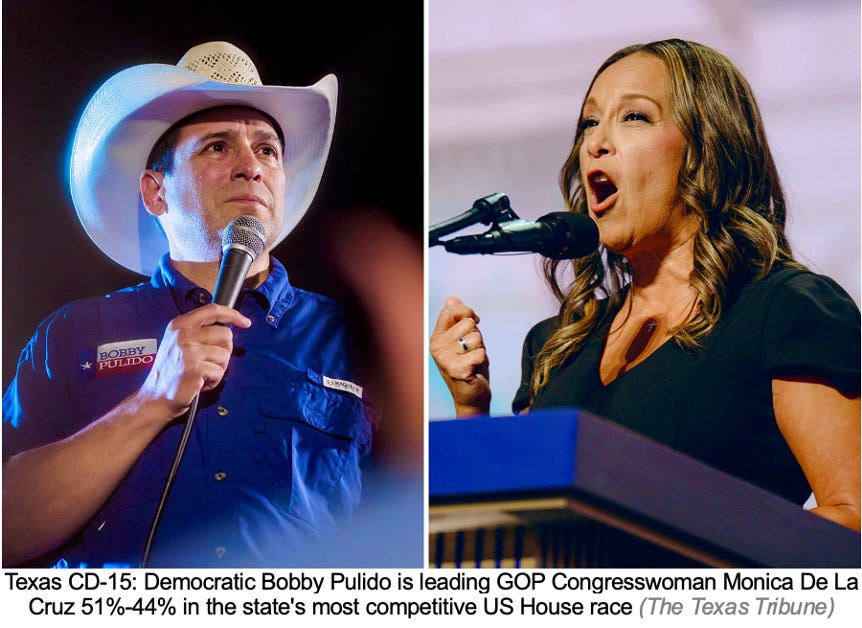
The fourth is represented by two-term Republican Congresswoman Monica De La Cruz, who is in a toss-up contest against Tejano musician Bobby Pulido (D) in the redrawn 15th District that now includes southeastern Hidalgo County and part of the Coastal Bend.
Nate Silver’s Bulletin has moved Democrats’ chances of taking the US Senate to the “Likely” category, with Texas as the single most important tipping-point state for control.
Texas Voter Resources
Sign up to Volunteer: linktr.ee/texastogether
Make a Plan to Vote: iwillvote.com
Voter Assistance Hotlines: 833.DEM.VOTE (833.336.8683)
Know Your Rights at the Polls: Here
DemList will keep you informed.
DemList
Connecting You to The Party
Connecting You to Each Other
Kimberly Scott
Publisher
Help sustain our work! Become a DemList Supporting Subscriber here on Substack, or make a one-time contribution here via ActBlue.